
Introduction
Incorporation in Singapore can be relatively straightforward once the required information is ready. The harder work often happens before the application, when founders must decide who will own the business, who will manage it, how it will be funded, and how it will handle ongoing administrative responsibilities.
These choices can look like registration details when the business is still new. However, a convenient decision made during incorporation in Singapore can later affect voting control, accounting, tax filing, banking arrangements, investor discussions, and day-to-day management.

Key Takeaways
- Ownership percentages can affect voting power, dividends, fundraising, and control, so founders should consider future changes as well as their initial contributions.
- Shareholders and directors perform different functions, making it important to define both ownership and founder responsibilities before registration.
- The legal minimum capital does not necessarily reflect the amount of money a business requires to operate through its early stages.
- Financial year-end, accounting processes, tax position, and registered office address can create recurring administrative consequences after incorporation.
- Planning for hiring, investors, GST registration, overseas expansion, and other likely changes can reduce the amount of restructuring required as the company develops.
Key Business Decisions to Clarify Before Incorporation in Singapore
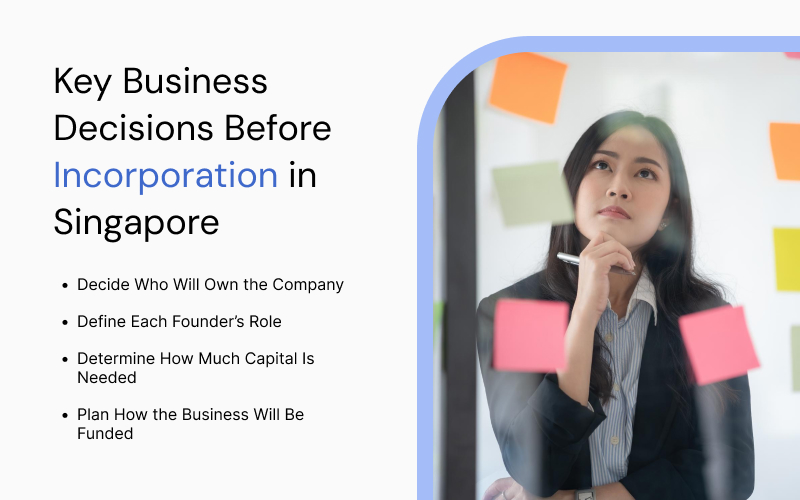
Before incorporation in Singapore, founders should settle several questions about how the company will work commercially. These decisions establish more than what appears on the initial registration; they can influence how authority, money, and responsibilities are divided once the company begins operating.
A company’s ownership structure can affect voting power, dividend entitlement, fundraising, and how much control different shareholders have over key decisions. This means the initial split between company shareholders deserves more thought than simply dividing shares based on who contributed the original idea or the most startup capital.
incorporation in Singapore is not whether 50/50 ownership is inherently appropriate or inappropriate. Founders should understand how they will make decisions if their views eventually diverge.
Consider Future Ownership
The ownership structure should also reflect what could happen beyond the first year. A technology startup intending to raise external investment may eventually issue additional shares, whereas a growing SME might want to introduce another shareholder or reward key employees.
Thinking through these possibilities before incorporation in Singapore can reveal whether the proposed structure has enough flexibility for likely changes. It also gives founders a chance to discuss dilution, voting control, and future ownership before those conversations happen under the pressure of an investment or expansion.
What Roles Will the Founders Actually Hold?
Ownership and management are closely connected in many new companies, but they are not the same thing. A shareholder owns an interest in the company, whereas a director participates in its governance and carries statutory responsibilities. Clarifying this during incorporation in Singapore helps founders separate company ownership from management responsibilities.
Defining Founder Roles
Two founders may both be shareholders and registered directors while performing very different jobs. One might lead sales, partnerships, and business development, while the other controls finance, operations, and recruitment.
Defining these founder responsibilities gives each person a clearer understanding of the decisions they are expected to make and reduces the likelihood of important tasks falling between them. This becomes more important as the company grows, as employees need to know which founder is responsible for each decision.
Foreign Founder Considerations
Overseas entrepreneurs may face another issue. A Singapore company must have at least one director who meets the applicable local residency requirements, so foreign founders should consider their directorship arrangements alongside the operational roles they intend to perform.
Where a nominee director in Singapore is being considered, founders should look beyond the incorporation requirement and consider how the directorship will fit into the company’s wider management structure. As directors have certain legal responsibilities, it helps to establish how their role will work alongside those actively running the business.

What Will the Company Actually Do?
During incorporation in Singapore, a company must identify its principal business activities based on what it actually intends to do. Choosing activities that are too broad or do not accurately reflect how the business earns revenue may raise questions later. A clear description can make dealings with banks, licensing authorities, grant providers, tax advisers, and other parties more straightforward.
Regulatory Requirements
Successful incorporation does not automatically authorise a company to conduct every possible business activity. Depending on the sector, additional licences, permits, approvals, or regulatory conditions may apply before operations can begin.
A founder planning a regulated activity should establish these requirements before making commitments based solely on the assumption that company registration is sufficient. Clarifying the actual business model beforehand gives founders time to identify these additional requirements and factor them into the launch plan.
Current vs Future Activities
Founders are naturally ambitious about where a new company might eventually go. A business established for consulting today may envisage software, training, overseas markets, or other services later.
The incorporation details should still provide a clear picture of what the company is being established to do now. Trying to accommodate every hypothetical future activity can make the description less useful without removing the need to update it if the business changes materially later.

How Much Capital Does the Business Really Need?
Capital deserves consideration at two levels: what is required to establish the company and what is realistically required to operate it. These figures can be very different. Considering the business funding structure before incorporation in Singapore can also help founders understand where operating cash will come from and how future funding may affect ownership.
Legal Minimum vs Operating Reality
A company requiring share capital can start with as little as S$1 in share capital. However, meeting that minimum does not mean the company has enough resources to operate.
A business may have rent, payroll, software subscriptions, professional fees, licences, inventory, insurance, and marketing costs before revenue becomes consistent. The amount required depends heavily on the business model. For incorporation in Singapore, founders should separate the legal starting point from the commercial reality of funding the business.
Plan for an Operating Runway
Founders should estimate how long the business can continue operating before it needs to become self-sustaining or secure additional funding. Depending on the business and its risk profile, planning scenarios might model 12 to 18 months of operating expenses.
This can help founders see whether the business has enough funds if revenue takes longer than expected. It can also reveal overlooked expenses and clarify how much funding the business may need.
Consider How the Business Will Be Funded
Businesses can be funded in different ways, including equity, shareholder funding, or future investment. Each option can affect accounting, ownership, cash flow, and how the company manages its finances.
For example, a startup planning to raise investment should consider how issuing new shares may affect existing ownership. Thinking about the funding approach before incorporation in Singapore helps founders choose an initial capital structure that better supports how the business intends to finance its operations.
Key Compliance and Administrative Decisions
Once the commercial structure is clearer, attention should turn to the company’s administrative framework. Decisions about the financial year, accounting, tax, and outsourced support can shape the company’s recurring workload long after incorporation.
Which Financial Year End Fits the Business?
The financial year end (FYE) determines the end of the company’s accounting period and affects its recurring reporting calendar. IRAS uses the company’s financial year as the base period for corporate income tax purposes, making the choice both operational and administrative.
Consider the Business Seasonality
A retailer generating a large proportion of annual sales during the year-end festive period faces a different workload from a consultancy with relatively consistent monthly revenue. Closing the accounts immediately after the busiest operational period could place additional pressure on an internal finance team or external accountant.
Additionally, stock counts, reconciliations, outstanding invoices, and other year-end work may arrive when employees are already managing peak commercial activity. Considering seasonality before incorporation in Singapore can help the company choose a reporting period that better fits its operating rhythm.
Aligned Reporting Periods
For a Singapore entity belonging to a wider corporate group, another consideration is whether its reporting period should align with the parent or related entities. Alignment can simplify management reporting and consolidation because entities produce information for corresponding periods. This can be ideal when a foreign business establishes a Singapore subsidiary as part of regional expansion.
Where Will the Company’s Registered Office Be?
The registered office is more than an address entered during incorporation in Singapore. It becomes the company’s official address for notices and communications and must meet Singapore’s applicable registered-office requirements. Founders should consider whether the proposed address will remain suitable once the company is operating, particularly if the initial premises are temporary.
A startup may initially use one location and move into permanent premises several months later. That can be managed, but recognising the likely move beforehand allows the founders to plan for the administrative update instead of treating the address as relevant only on registration day.
How Will Accounting Records Be Managed?
Accounting can feel like a later-stage concern when a newly incorporated company has only a few transactions. That perception changes quickly once founder expenses, customer invoices, bank transactions, reimbursements, payroll, and supplier payments start to accumulate.
Establishing the record-keeping process around the time of incorporation in Singapore can prevent the first accounting exercise from becoming a reconstruction of several months of activity.
Match the Accounting System to the Business
A consultancy issuing a small number of invoices may have very different bookkeeping needs from an e-commerce business processing large transaction volumes. Thinking about accounting software, invoicing, expense records, payroll, and bank reconciliation early can prevent the company from having to reconstruct records later.
Use Records to Support Decisions
Good accounting records serve a commercial purpose as well as a compliance one. Reliable management information allows founders to monitor cash flow, margins, spending, and overall performance.
Instead of discovering a cash shortage when the bank balance becomes critical, they can use current records to spot trends and act earlier. This is where incorporation in Singapore naturally connects with ongoing accounting services. The company structure establishes the entity, but reliable financial records help founders understand what that entity is doing once trading begins.
What Tax Obligations Could Arise From the Business Model?
Revenue sources, overseas dealings, related companies, employee costs, founder remuneration, and deductible expenses can all affect the company’s tax position. Tax planning around incorporation in Singapore should consequently begin with how the company expects to conduct business, not simply with the statutory rate.
Plan for GST
A startup may not need GST registration immediately, but this can change as the business grows. Compulsory registration may apply when taxable turnover exceeds S$1 million or is expected to exceed this amount within the next 12 months.
Growing businesses should monitor their turnover and consider how GST services in Singapore may support invoicing, record-keeping, pricing, and other GST requirements.
Consider Cross-Border Tax
Foreign founders and Singapore companies conducting cross-border transactions can face additional tax questions. Depending on the circumstances, these may involve tax residency, withholding tax, transfer pricing, related-party transactions, or overseas income.
They do not necessarily prevent incorporation in Singapore, but identifying likely issues early allows the company to establish records and processes that support later compliance. This becomes important where transactions with overseas related companies are expected from the beginning.
What Will Be Outsourced?
Company registration starts an ongoing compliance cycle. Corporate secretarial work, bookkeeping, payroll, annual filings, GST where applicable, and corporation tax filing can continue throughout the company’s life.
Consider Internal Resources
The appropriate arrangement depends on the company. An established organisation opening another entity may already have finance and administrative employees capable of handling much of the work.
A two-person startup completing incorporation in Singapore, on the other hand, may gain little from building a full internal finance and compliance function before the business has sufficient scale to justify it. For the latter, outsourcing accounting can shift part of that fixed administrative workload to external professional support while internal resources stay focused on operations and growth.
The Importance of Bundled Support
Outsourcing does not automatically solve coordination problems. If bookkeeping, payroll, tax, and corporate secretarial work are handled independently, information may not move between the parties when it becomes relevant.
Connecting these functions can reduce those gaps. For founders using business incorporation services, it is worth considering what happens after registration and whether the same support structure can connect company administration with accounting, payroll, GST, and tax obligations throughout the year.
What Are the Future Plans for the Company?
A company should be established for the business founders realistically expect to build, not only for its condition on incorporation day. A small owner-managed consultancy, an investment-seeking technology startup, and a foreign group establishing a regional operation have very different likely requirements.
Discussing these plans before incorporation in Singapore can reveal decisions that may otherwise need revisiting soon afterwards. A company planning to hire employees soon after registration should also prepare for payroll, employment administration, CPF obligations where applicable, and potential work pass requirements.
Think About Expansion Plans
Growth can change a business’s administrative profile considerably. Rising transaction volumes can make the original bookkeeping process impractical, while turnover growth may bring GST registration into consideration.
A clean starting structure cannot eliminate these changes. It can reduce the likelihood that normal growth immediately exposes weaknesses in decisions made during incorporation in Singapore.

How KBW Group Supports the Incorporation Process
At KBW Group, incorporation starts through our RoboCorp platform, where founders can submit their company information online. Our team then reviews the submission, prepares the required documents, and handles the ACRA registration process. This combines an online application process with a team review before the company is registered.
Support can also continue after incorporation through the same group. Our corporate secretarial team handles areas such as annual returns, statutory registers, resolutions, and company records, while our accounting team can manage bookkeeping, financial reporting, GST filing, and year-end accounts. For businesses that require a digital accounting setup, we also work with systems such as Xero, QuickBooks Online, and OCR tools.
Bringing these functions together means information established during incorporation can feed into the company’s subsequent secretarial, accounting, and tax work, instead of each requirement being approached separately. Our tax services include corporate tax returns and ECI preparation, GST registration and filing, and tax advisory, giving businesses a path from registration to ongoing compliance.
Conclusion
The most important incorporation decisions extend well beyond choosing a company name and completing the registration application. Ownership, directors’ roles, business activities, capital, financial year-end, accounting, tax, outsourcing, and growth plans can all influence how easily the company operates once registration is complete.
At KBW Group, we view incorporation as the beginning of a longer compliance and financial journey. By considering how the initial structure connects with corporate secretarial requirements, accounting and bookkeeping services, payroll, GST, and corporate tax, founders can make decisions with the company’s actual operations in mind. For startups, SMEs, and foreign entrepreneurs, resolving these questions early can reduce unnecessary restructuring and create a clearer foundation for growth.
Speak with our team to discuss how we can support your proposed company structure from incorporation through ongoing accounting, tax, and compliance.
Frequently Asked Questions
1. Do all incorporation decisions need to be final before registering a company in Singapore?
No. Many company particulars can be changed after incorporation. However, changes to areas such as shareholders, directors, financial year end, business activities, or capital can involve additional filings, documentation, approvals, or professional work.
2. What incorporation choices are difficult to fix later?
Many company details can be changed, but changes to shareholding, director arrangements, capital structure, or governance can require more documentation and coordination than changing basic administrative details. These are the areas founders usually benefit from considering more carefully before incorporation.
3. Can the company change its business activities after incorporation?
Yes. Business activities can generally be updated later, but the company may also need to consider whether the new activity requires additional licences, approvals, or regulatory compliance. This is why the initial business description should reflect what the company genuinely expects to do.